What the reform asks for
Under the reform, an invoice between French businesses is no longer a PDF sent by email. It is a structured document — which software can read without retyping — exchanged through a plateforme agréée (PA, formerly called PDP), a platform approved by the tax administration. The platform delivers the invoice to your customer's platform and reports the data the administration needs.
Three formats are accepted; SoliCRM uses Factur-X, the one that reads like a normal invoice for people and like data for software.
Every invoice is a Factur-X
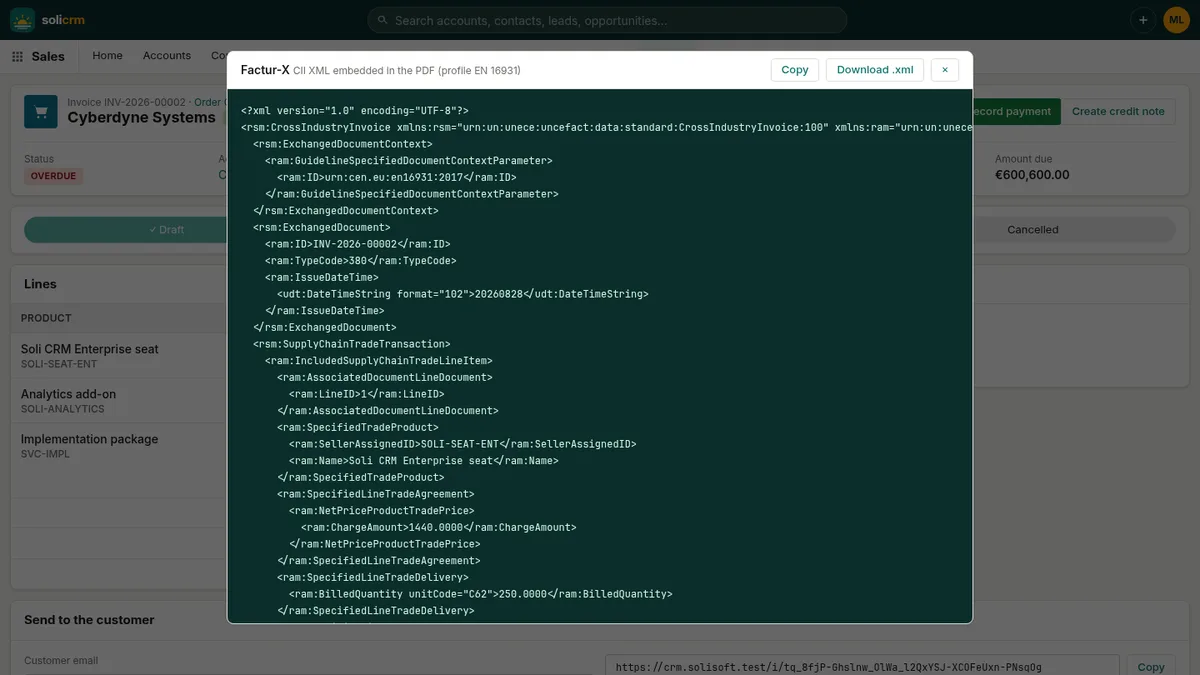
Every invoice and credit note SoliCRM produces is a Factur-X: a PDF/A-3 that your customer reads as usual, with an EN 16931 XML file inside that carries everything a machine needs:
- seller and buyer, with their VAT and SIREN/SIRET numbers and addresses;
- every line with its quantity, unit price, discount and VAT rate;
- the VAT breakdown, totals, due date and payment terms;
- your IBAN and BIC for the transfer;
- for a credit note, the invoice it corrects (type code 381); for a deposit invoice, type code 386; for a final invoice, the deposits already paid and the invoices they came from.
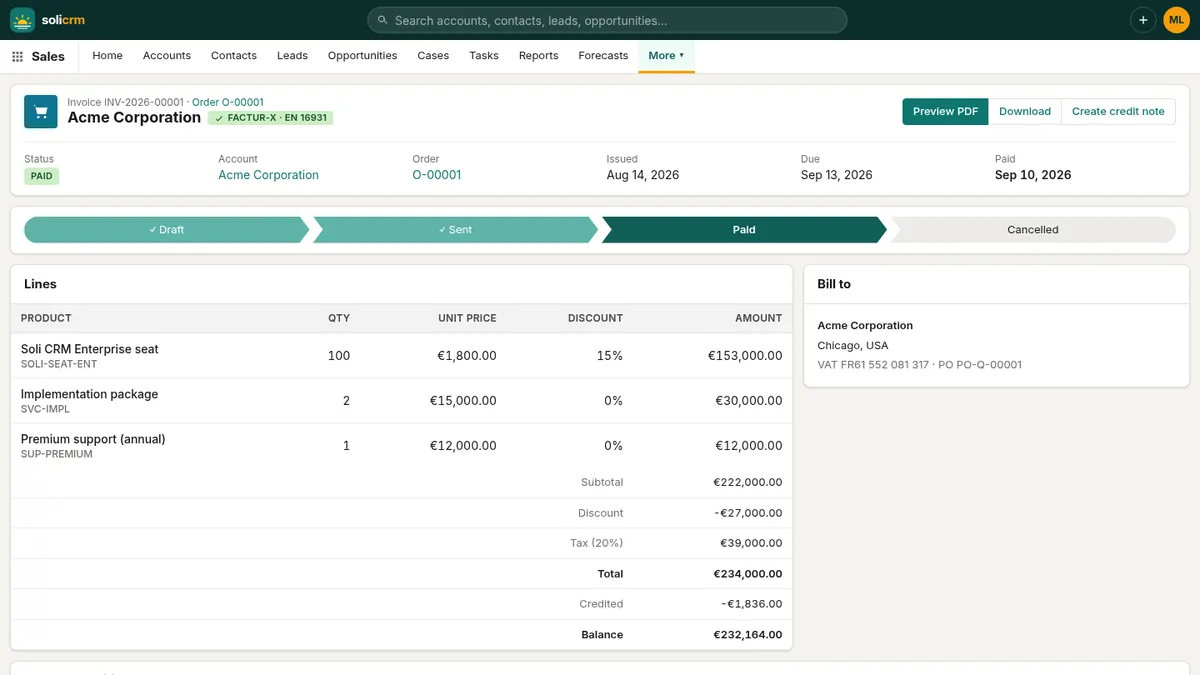
A Factur-X badge on the invoice opens a viewer showing the embedded XML, readable, with a button to download it. Nothing to install, nothing to convert.
To make your invoices complete, fill in Setup → Company (legal name, VAT number, SIREN, address, IBAN) and the SIRET or VAT number on your customers' accounts. SoliCRM uses them as they are.
Connected to your platform
In Setup → E-invoicing, connect the platform you chose:
- Pennylane
- Qonto
- Iopole
- Jefacture (Banqup API)
- Chorus Pro, for invoices to the public sector
- any other platform that accepts a Factur-X upload, through a generic connector (API address, token, optional OAuth)
Each connection has its credentials — kept encrypted, never shown again — and an environment, sandbox or production, so you can test before going live. Mark one as the default.
Transmit, then follow it
On an issued invoice or credit note, Transmit sends the Factur-X to your platform. Drafts cannot be transmitted: what goes out is always a numbered, final document.
SoliCRM then follows the invoice on the platform and translates each platform's vocabulary into one simple status:
- sent — the platform has it;
- processing — it is being checked and routed;
- delivered — it reached your customer's platform;
- accepted or rejected — your customer's answer;
- paid — when the platform reports the payment.
Statuses refresh on their own every 30 minutes, or on demand. Every transmission is listed on the invoice with its date, platform, status and the platform's reference, and a failed one says why.
In short
- Every invoice and credit note is a Factur-X (PDF/A-3 + EN 16931 XML).
- Deposits, final invoices and credit notes carry the right type codes and references.
- Pennylane, Qonto, Iopole, Jefacture, Chorus Pro or any Factur-X platform.
- Transmission in one click, status followed every 30 minutes.
Previous: deposits, progress invoices and retention.